
Texas is big. Between the cities, there are long stretches of highway where the next town, truck stop or repair shop can be a long way off. Think I-20 west of Abilene, I-10 between San Antonio and El Paso, US-287 toward Amarillo or the farm roads that connect small towns.
A breakdown in Dallas is stressful. A breakdown in the middle of nowhere, with spotty cell service and the sun going down, is a different kind of challenge.
Here’s how to stay safe and get help faster when you break down far from the city, whether you drive a semi, a box truck or a pickup.
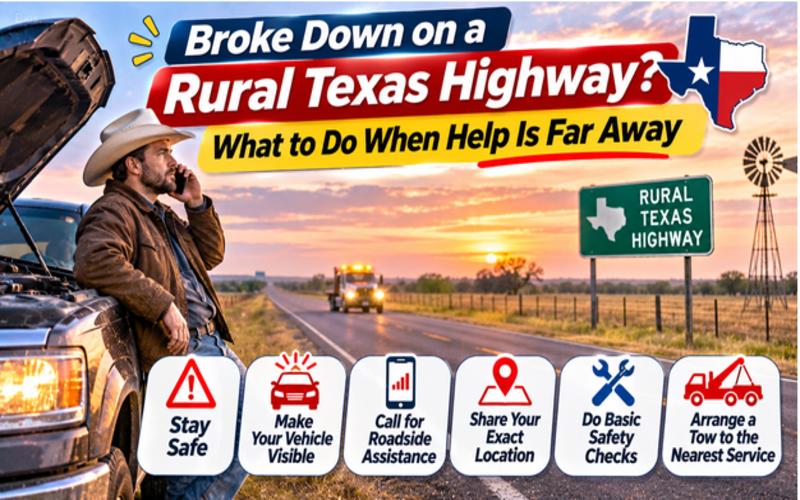
If you break down on a rural Texas highway, get as far off the road as possible, turn on hazards and set out triangles. Note your highway, direction and mile marker, since rural roads may not have nearby exits. If you have weak cell service, try a text, which can go through when calls fail. Stay with your vehicle, conserve your phone battery and water, and call a roadside service that covers all of Texas, not just one city.
Why Rural Breakdowns Are Different
- Longer response times. Help may have to travel a long distance.
- Weak cell service. Some areas have spotty or no signal.
- Fewer landmarks. It’s harder to describe where you are.
- Weather exposure. Summer heat and winter cold are tougher with no shelter nearby.
- Wildlife and livestock near the road, especially at night.
- Fast traffic on two-lane roads with narrow shoulders.
Step 1: Get Off the Road Safely
Rural highways often have narrow or no shoulders. If the truck is still rolling:
- Look for a wide shoulder, ranch gate turnout, rest area or crossroads.
- Avoid stopping on a curve or hill where drivers can’t see you.
- On two-lane roads, get as far to the right as you can.
Once stopped, turn on your hazards right away and set out reflective triangles. Commercial drivers must place warning devices within 10 minutes of stopping.
Step 2: Figure Out Exactly Where You Are
On a rural road, “near Sweetwater” covers a lot of ground. Note:
- Highway number and direction, like westbound I-20 or northbound US-287
- Mile marker, the small green signs along interstates
- Last town or exit you passed
- Nearby landmarks: a grain elevator, water tower, church or ranch name
- GPS coordinates from your phone’s map app, even without data
Most phones can show GPS coordinates without a cell signal, because GPS uses satellites. Write them down.
Step 3: Get the Message Out
If you have a weak signal:
- Try texting. Texts often go through when calls drop.
- Move a little higher if it’s safe, or try the other side of the truck.
- Use Wi-Fi calling if you’re near a gas station or rest area with Wi-Fi.
- Call 911 in an emergency. Even with a weak signal, 911 calls may connect through any available carrier.
- Use satellite messaging if your phone or device supports it.
Tell your dispatcher, family or fleet manager where you are, even before help is confirmed.
Step 4: Stay Safe While You Wait
- Stay with your vehicle. It’s easier to find, and walking along a rural highway is dangerous.
- Conserve your phone battery. Lower screen brightness and close apps.
- Ration water and food.
- In summer: find shade if you can, and keep drinking water. Texas heat can become dangerous quickly.
- In winter: stay inside with warm layers. Only idle the engine with a clear exhaust and good ventilation.
- At night: keep hazards and marker lights on, and wear a reflective vest if you step outside.
Step 5: Decide Between Roadside Repair and Towing
In rural areas, the closest shop might be far away, so a roadside fix can save a lot of time.
| Problem | Usually fixed on-site? |
|---|---|
| Tire blowout or flat | Yes, with tire replacement |
| Dead batteries | Yes |
| Out of fuel | Yes, with fuel delivery |
| Air leaks | Usually |
| Sensor faults and many derates | Often |
| Major engine or transmission failure | No, needs a tow |
| Accident damage | Usually needs a tow |
When a tow is needed, our semi truck towing and heavy duty towing teams can move the truck to the nearest suitable shop or back to your yard.
Pack for Rural Routes
If you regularly drive through West Texas, the Panhandle or South Texas, keep extra supplies in the cab:
- Several gallons of water
- Non-perishable food
- Power bank and charging cables
- Flashlight and extra batteries
- First aid kit
- Blanket and warm clothes
- Sun protection
- Spare fuel filter and basic tools
- Paper map of the region
Plan Ahead on Long Routes
- Fuel up early. Don’t count on the next town having diesel.
- Check your truck before long runs: tires, coolant, batteries and air system.
- Share your route with dispatch or family.
- Know where truck stops and repair options are along your route.
- Save a statewide roadside number, not just a local one.
Roadside Help Across All of Texas
Alpha Roadside Service provides 24/7 roadside assistance, mobile diesel mechanic service, semi truck repair and towing across Texas. From Dallas, Richardson and Mesquite to rural highways statewide, our dispatch team will find the fastest way to get you moving.
Call +1 (855) 457-1170 or request a service.
Frequently Asked Questions
What should I do if my truck breaks down on a rural Texas highway?
Get off the road, turn on hazards, set out triangles, note your mile marker and location, and call for roadside help.
How do I share my location with no cell signal?
Your phone’s GPS can often show coordinates without data. Try texting them, since texts may go through when calls fail.
Should I walk to the nearest town?
Usually no. It’s safer to stay with your vehicle unless you’re in immediate danger.
Can a roadside mechanic reach rural areas?
Yes, though it may take longer. Many tire, battery, fuel and air system problems can be fixed on-site.
What should I keep in my truck for rural routes?
Water, food, a power bank, flashlight, first aid kit, warm clothes, sun protection and basic tools.