If you search “diesel truck inspection,” you’ll mostly find emissions testing pages and forum threads full of drivers asking the same questions. What actually gets checked? Which inspection do I need? Why did my truck fail?
This guide answers those questions in plain language. You’ll learn the difference between the inspections commercial trucks go through and what a diesel mechanic checks, system by system.
At Alpha Roadside Service, our diesel mechanics inspect and repair semi trucks, box trucks, trailers and heavy-duty trucks across Texas, so this is based on what we see on real trucks every week.
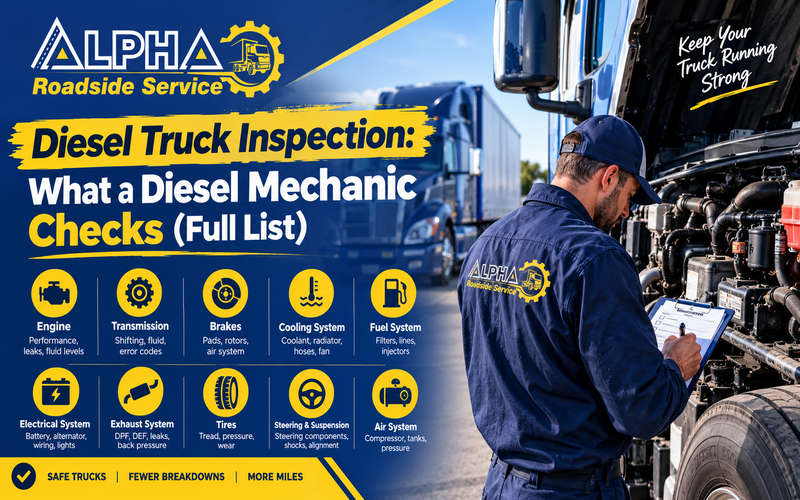
During a diesel truck inspection, a diesel mechanic checks the brakes and air system, tires and wheels, steering, suspension, lights and electrical, coupling devices, fuel and exhaust systems, frame, windshield and wipers, plus engine fluids, belts, hoses, the cooling system, emissions components and fault codes. A DOT annual inspection focuses on safety items listed by the FMCSA, while a preventive maintenance inspection also covers engine and wear items.
Which Truck Inspection Are We Talking About?
A big source of confusion is that “truck inspection” can mean several different things.
| Inspection type | Who does it | How often | What it focuses on |
| Pre-trip / post-trip | The driver | Every trip | Quick safety walk-around and in-cab checks |
| Preventive maintenance (PM) | A diesel mechanic | By miles, hours or time | Safety items plus engine, fluids and wear parts |
| DOT annual inspection | A qualified inspector | At least every 12 months | Federal safety standards for commercial vehicles |
| Roadside inspection | Law enforcement or state inspectors | Random or targeted | Compliance with safety rules, driver and vehicle |
| State emissions or safety test | Licensed inspection station | Varies by state | State-specific requirements |
Most of what a diesel mechanic checks falls under PM inspections and DOT annual inspections. Let’s walk through them.
What Is a DOT Annual Inspection?
Commercial motor vehicles in the US must pass a periodic inspection at least once every 12 months under FMCSA rules (49 CFR 396.17). The inspector must be qualified, and the vehicle must carry proof of the inspection, such as a report or decal.
The inspection covers the minimum standards listed in FMCSA’s Appendix G. Here’s what that includes, in plain English.
What a Diesel Mechanic Checks, System by System
Brakes and Air System
Brakes are one of the most important parts of any inspection, and brake problems are among the most common reasons trucks are taken out of service.
A mechanic checks:
- Brake adjustment and slack adjusters
- Brake chambers, including spring brakes
- Brake drums, rotors, shoes and pads for wear or cracks
- Air lines and hoses for leaks, chafing or damage
- Air compressor, governor and air dryer
- Air pressure build-up time and leak-down rate
- Low-air warning device
- Parking brake operation
- ABS warning light and system
Tires and Wheels
- Tread depth on steer, drive and trailer tires
- Cuts, bulges, exposed belts or sidewall damage
- Proper inflation
- Matching duals
- Cracked wheels or rims
- Loose, missing or damaged lug nuts
- Hub oil levels and seal leaks
Need a tire replaced after an inspection? Our tire replacement service comes to you.
Steering
- Steering wheel free play
- Steering gear box for leaks and mounting
- Tie rods, drag links and pitman arm
- Power steering fluid and hoses
Suspension and Frame
- Leaf springs for cracks or missing leaves
- Air bags for leaks or damage
- U-bolts, spring hangers and torque rods
- Frame rails for cracks, bends or loose fasteners
Lights and Electrical
- Headlights, tail lights and brake lights
- Turn signals and hazard lights
- Clearance and marker lights
- Reflectors and reflective tape
- Wiring condition
- Battery mounting and cable condition
Coupling Devices
- Fifth wheel mounting, locking jaws and release handle
- Kingpin and upper coupler on the trailer
- Safety chains and pintle hooks where used
- Gladhands and electrical connections between truck and trailer
Fuel and Exhaust Systems
- Fuel tanks mounted securely with no leaks
- Fuel caps in place
- Exhaust system with no leaks under the cab or sleeper
- Exhaust parts secured and not touching wiring, fuel lines or brake lines
Windshield, Wipers and Mirrors
- Cracks or damage in the driver’s view
- Wiper blades and washer operation
- Mirrors secure and usable
What a PM Inspection Adds
A diesel mechanic doing a preventive maintenance inspection goes beyond the DOT safety list. These checks keep the truck running and catch wear before it becomes a breakdown.
Engine and fluids:
- Engine oil level and condition, plus oil and filter changes on schedule
- Coolant level, strength and leaks
- Transmission and differential fluid levels
- Fuel filters and water separators
- Air filter restriction
Belts, hoses and cooling:
- Belt wear, cracks and tension
- Hose condition, clamps and leaks
- Radiator and charge air cooler for damage or blockage
- Fan clutch operation
Emissions and aftertreatment:
- DEF level and quality
- DPF condition and regeneration history
- EGR system and sensors
- Active fault codes and history
Diagnostics:
Modern trucks store a lot of information in the ECM. A diesel mechanic with the right scan tool can pull fault codes, check sensor readings and spot trends that aren’t visible yet. Our technicians use diagnostic tools for Volvo, Detroit, Cummins and PACCAR systems.
Common Reasons Trucks Fail Inspection
From what we see in the field, these come up again and again:
- Brakes out of adjustment
- Air leaks
- Worn or damaged tires
- Burned-out lights
- Oil or fluid leaks
- Cracked windshields
- Loose or missing lug nuts
- Damaged air lines or electrical lines between the truck and trailer
Most of these are quick, inexpensive fixes if they’re caught early. Many can be repaired on-site.
What About Texas Inspections?
Texas changed its vehicle inspection rules in recent years, and requirements depend on the vehicle type, weight and use. Commercial vehicles still have safety inspection requirements, and federal DOT annual inspection rules apply to commercial motor vehicles across the country.
Emissions testing rules in Texas vary by county and vehicle type. Because these rules can change, check the Texas Department of Public Safety (DPS) for the latest requirements for your specific vehicle.
How to Prepare Your Truck for Inspection
- Do a thorough pre-trip and fix anything you find.
- Check all lights, including trailer and marker lights.
- Look at tires for tread depth and damage.
- Listen for air leaks with the engine off.
- Clean the windshield and check the wipers.
- Have maintenance records ready.
- Address warning lights before the inspection.
Need a Diesel Mechanic Near You?
Alpha Roadside Service offers on-site inspections, PM service and diesel truck repair across Texas. We work on semi trucks, box trucks, trailers, heavy-duty trucks, commercial fleets and RVs.
We serve Dallas, Richardson, Mesquite and drivers across Texas. Call +1 (855) 457-1170 or request a service. Fleets can also become a member for ongoing support.
Frequently Asked Questions
What does a diesel mechanic check during a truck inspection?
Brakes, air system, tires, wheels, steering, suspension, lights, coupling devices, fuel and exhaust systems, frame, windshield and wipers. A PM inspection also checks fluids, belts, hoses, cooling, emissions parts and fault codes.
How often does a commercial truck need a DOT inspection?
At least once every 12 months under FMCSA rules.
What is the most common reason trucks fail inspection?
Brake problems are among the most common, along with tires, lights and air leaks.
What’s the difference between a PM inspection and a DOT inspection?
A DOT annual inspection checks federal safety standards. A PM inspection adds engine, fluid, emissions and wear checks to prevent breakdowns.
Can a mobile diesel mechanic do a truck inspection?
Yes. Many inspections and the repairs they find can be done on-site at your yard or location.