A truck can be perfectly maintained and still end up stranded.
A battery fails. A tire gives out. A hose splits. The truck runs out of diesel. An electrical fault suddenly prevents it from starting.
When that happens, calling for “roadside assistance” sounds simple—but what will the technician actually be able to do when they arrive?
For commercial drivers, owner-operators, and fleet managers, roadside assistance can cover much more than a basic jump start.
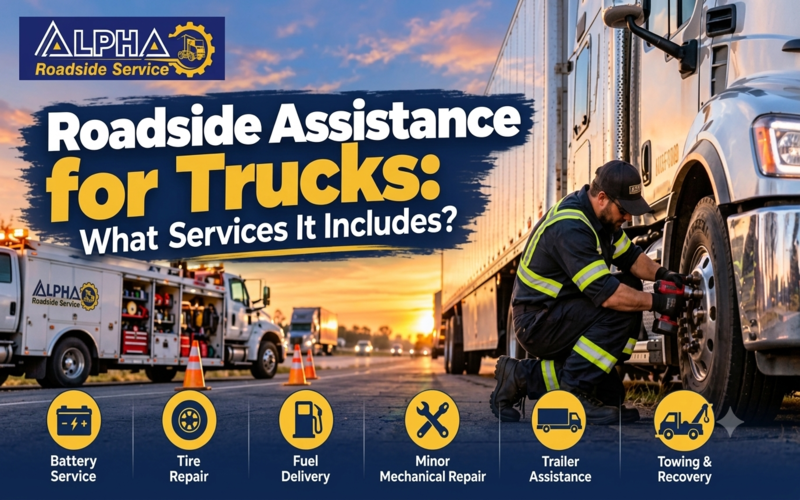
Depending on the provider and the breakdown, roadside assistance for trucks may include battery service, commercial tire assistance, fuel delivery, electrical troubleshooting, minor mechanical repairs, trailer service, recovery, and towing.
Here is what drivers should expect—and how to know which service they actually need.
What Is Commercial Truck Roadside Assistance?
Commercial truck roadside assistance sends help directly to a disabled truck rather than automatically sending the vehicle to a repair shop.
The objective is straightforward:
Diagnose the problem, solve it at the truck’s location when practical, and tow the vehicle when it cannot be safely repaired there.
That can be especially valuable for commercial vehicles because towing a tractor, trailer, box truck, or other heavy vehicle is very different from moving a passenger car.
Roadside service can potentially avoid that process altogether when the failure is relatively minor.
What Does Roadside Assistance for Trucks Include?
Services vary among providers, but these are some of the most common roadside needs.
| Breakdown | Typical Roadside Service | Tow Usually Required? |
| Dead battery | Jump start/battery service | Usually no |
| Flat or damaged tire | Tire repair/change/replacement | Often no |
| Out of diesel | Fuel delivery | Usually no |
| DEF-related problem | Delivery/diagnosis where applicable | Depends on fault |
| Minor electrical fault | Diagnosis and accessible repair | Sometimes |
| Broken hose or belt | On-site replacement | Sometimes |
| Air-line problem | Leak/fitting repair | Sometimes |
| Trailer light fault | Electrical repair | Usually no |
| Locked cab | Lockout assistance | Usually no |
| Truck stuck off-road | Winching/recovery | Depends |
| Major engine failure | Towing | Usually yes |
| Major transmission failure | Towing | Usually yes |
| Collision/structural damage | Recovery and towing | Often yes |
Understanding these categories can help you describe the breakdown accurately when calling dispatch.
1. Jump Starts and Battery Service
A truck that will not start is one of the most common reasons to request roadside assistance.
But a no-start condition does not always mean the battery itself is bad.
Roadside battery service can involve checking the batteries and connections, providing an appropriate heavy-duty jump start, and determining whether another starting or charging-system problem may be responsible.
If the truck starts after a jump but immediately develops charging problems, simply driving away without investigating the cause could leave you stranded again.
That is why diagnosis matters.
2. Commercial Truck Tire Service
A tire failure can stop a tractor-trailer even when every mechanical system on the truck is working correctly.
Truck roadside service may include:
- Tire inspection
- Inflation
- Tire changes
- Roadside tire repair where appropriate
- Tire replacement where available
The appropriate solution depends on the type and extent of damage.
Not every damaged commercial tire should be repaired. Severe sidewall damage, major tread separation, wheel damage, or other safety concerns can require replacement or additional service.
3. Emergency Fuel Delivery
Running out of diesel is frustrating, but it does not normally justify towing an otherwise operational truck.
A roadside provider can deliver diesel directly to the vehicle.
For a diesel engine that has been run completely dry, however, adding fuel may not always be the end of the job. Depending on the fuel system, additional steps may be necessary before the engine will restart.
When requesting fuel delivery, tell dispatch what vehicle you are driving and whether the engine stopped because the tank ran empty.
4. Minor Mechanical Repairs
This is where commercial roadside assistance becomes much more useful than a simple emergency fuel-and-battery service.
Depending on the provider, technician, truck, and failure, roadside mechanical assistance may address problems involving:
- Belts
- Hoses
- Fittings
- Accessible coolant leaks
- Air lines
- Connections
- Filters
- Minor mechanical components
The objective is not to perform a major overhaul on a highway shoulder. It is to determine whether a manageable component failure can be repaired safely without towing the truck.
5. Electrical and Lighting Repair
A small electrical problem can have a large operational impact.
Truck and trailer electrical systems can develop problems involving lights, connectors, fuses, wiring, batteries, or other accessible components.
Roadside electrical troubleshooting can help determine whether the fault is something that can be repaired immediately or whether more extensive shop diagnosis is required.
For commercial vehicles, trailer-light problems are especially important because “the truck still drives” does not necessarily mean the combination is safe or legal to continue operating.
6. Truck and Trailer Roadside Repair
Commercial roadside service should not stop at the tractor.
A loaded trailer can develop an air leak, lighting problem, tire failure, brake-related issue, or electrical fault that prevents the combination from safely continuing its route.
Having roadside support capable of assessing both the truck and trailer reduces the need to coordinate multiple companies for the same breakdown.
For fleets, that can also make dispatch and documentation considerably easier.
7. Lockout Assistance
A driver can have a perfectly functional truck and still be unable to move because the keys are locked inside.
Lockout assistance is a straightforward roadside service designed to regain access without turning a simple mistake into hours of downtime.
When calling, be prepared to verify the vehicle and your authority to access it.
8. Winching and Recovery
Roadside assistance is not always about something mechanically failing.
A truck may be operational but unable to move because it is stuck in mud, soft ground, a ditch, or another difficult location.
That situation may require winching or recovery equipment rather than mechanical repair.
Heavy commercial vehicles require appropriately rated recovery equipment and experienced operators. Trying to pull a loaded commercial truck with unsuitable equipment can make the situation more dangerous and potentially damage the vehicle.
9. Commercial Truck Towing
Sometimes roadside repair simply is not the right answer.
A truck may need towing because of:
- Major engine damage
- Major transmission or drivetrain failure
- Serious brake or steering problems
- Collision damage
- Severe wheel or suspension damage
- Repairs requiring extensive disassembly
- Unsafe roadside working conditions
A roadside provider that can coordinate the transition from diagnosis to towing can make this process easier.
Instead of calling one company to inspect the truck and another after discovering it cannot be repaired, the breakdown can move directly to the next appropriate step.
Roadside Repair vs. Towing: Which Do You Need?
A simple way to think about the decision is:
Choose roadside repair when: the failure can be diagnosed, safely accessed, and repaired at the location.
Choose towing when: the truck cannot be safely restored to roadworthy condition at the location or the repair requires shop equipment, extensive disassembly, or controlled working conditions.
Do not make the decision based only on whether the engine can still run.
A truck with a serious brake, steering, tire, or structural problem may be capable of moving but still be unsafe to drive.
What Information Should You Give Roadside Dispatch?
The quality of the information you provide can make a major difference.
Before calling commercial truck roadside assistance, gather as much of the following as possible:
- GPS location
- Highway and direction of travel
- Exit number or mile marker
- Truck make and model
- Tractor and trailer type
- Whether the vehicle is loaded
- Tire size if requesting tire service
- Dashboard warning messages
- Visible leaks or damaged components
- Whether the engine starts or cranks
- Whether the vehicle is blocking traffic
- Photos when they can be taken safely
Instead of saying, “My truck broke down,” explain what actually happened.
For example:
“The truck lost power, the coolant warning appeared, and I can see coolant underneath the passenger side.”
That gives dispatch considerably more useful information.
What Should You Do While Waiting for Roadside Assistance?
Your first priority should be safety—not diagnosing the truck yourself beside moving traffic.
If possible, move the vehicle away from active traffic without creating another hazard.
Use the vehicle’s hazard warning system. Commercial drivers should also follow applicable requirements for emergency warning devices.
Stay away from traffic lanes and avoid working underneath or beside the vehicle in an unsafe roadside position.
If the truck is in an immediately dangerous position or a collision has created an emergency, contact emergency services first.
24-Hour Roadside Assistance in Texas
Commercial trucks do not operate only between 9 and 5, so breakdown support cannot either.
For drivers searching for 24 hour roadside assistance in Texas, Alpha Roadside Service provides roadside diesel truck repair and towing support for light-, medium-, and heavy-duty trucks.
The practical advantage is having access to multiple possible solutions through one roadside contact.
A dead battery may need a jump start. A damaged hose may need a mobile repair. A tire failure may need roadside tire service. A major mechanical failure may need towing.
The goal is not to tow every disabled truck.
It is to determine the most appropriate way to get that truck—and its driver—safely moving again.
Frequently Asked Questions
Does truck roadside assistance include towing?
It can. Some providers focus only on non-towing roadside services, while others provide or coordinate both roadside repair and towing. Confirm the provider’s capabilities when calling.
Can roadside assistance jump-start a semi-truck?
Yes, providers equipped for commercial vehicles can perform heavy-duty jump starts. Semi-trucks have different battery and electrical requirements from passenger cars, so tell dispatch exactly what vehicle you have.
Can roadside assistance fix a truck tire?
Many commercial roadside providers offer tire service. Whether a tire can be repaired depends on its condition and damage. Some failures require replacement rather than repair.
Does roadside assistance deliver diesel?
Yes. Fuel delivery is a common roadside service. A diesel engine that has completely run dry may require additional attention before restarting.
Can a mobile mechanic repair my truck instead of towing it?
Often, yes. Batteries, belts, hoses, electrical faults, air-line problems, tire issues, and other accessible failures may be repairable on-site. Major engine, transmission, structural, or safety-critical failures may require towing.
What should I search for if my semi-truck breaks down?
Terms such as “roadside assistance for trucks,” “commercial truck roadside assistance,” “mobile diesel mechanic,” or “truck roadside service” can help locate providers. Tell the provider your vehicle type before dispatch to make sure it has equipment appropriate for commercial trucks.
Is commercial truck roadside assistance available 24 hours?
Many commercial providers operate around the clock because trucks and fleets run overnight, on weekends, and on holidays. Alpha Roadside Service lists its roadside assistance as available 24 hours a day.
Conclusion
Truck roadside assistance is no longer limited to delivering a little fuel or providing a jump start.
For commercial vehicles, the right roadside provider can act as the first response to a breakdown—assessing the situation and providing battery service, tire assistance, fuel delivery, electrical troubleshooting, minor mechanical repair, trailer support, recovery, or towing depending on what the truck actually needs.
That flexibility matters because the fastest solution is not always a tow.
Sometimes a relatively small repair is all that stands between a stranded truck and the rest of its route.
And when the problem is too serious for roadside repair, recognizing that quickly and arranging the right tow is just as important.