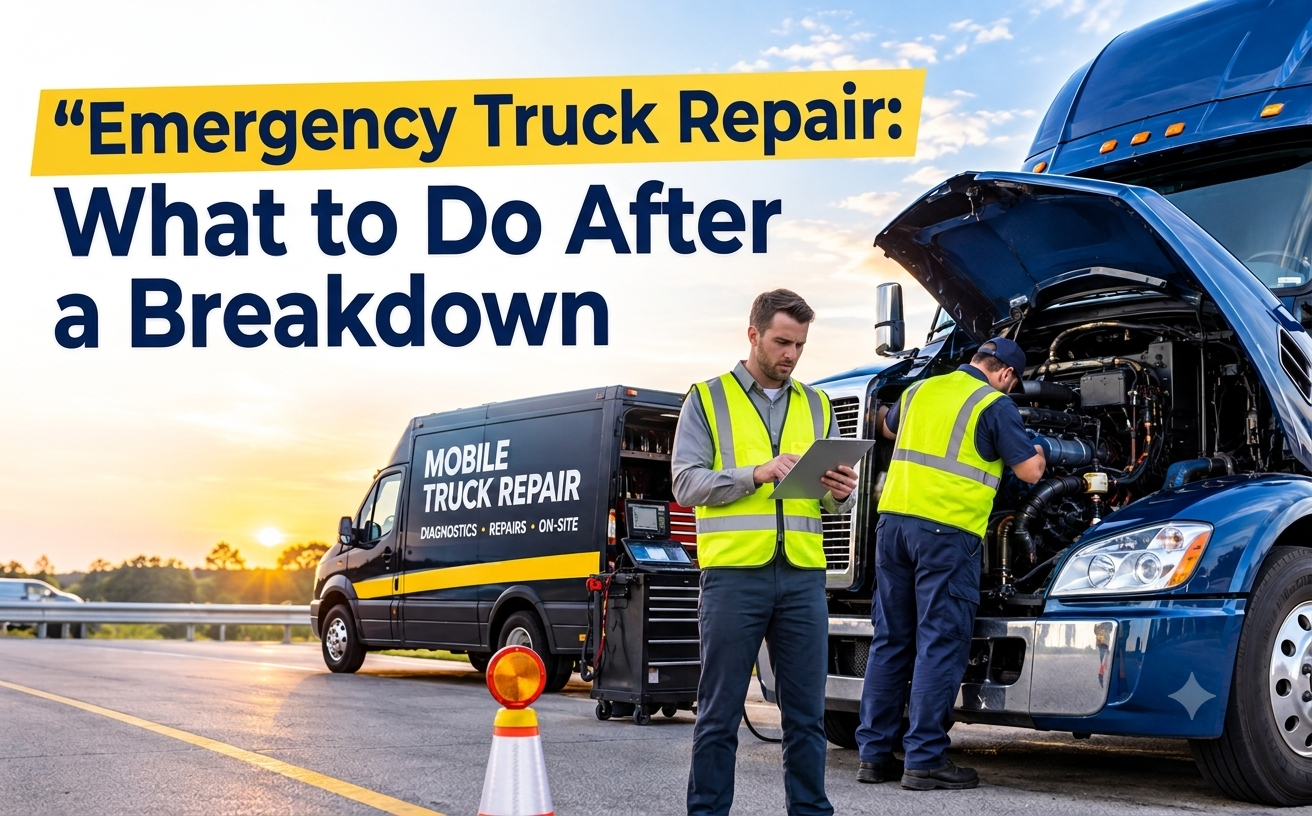
A commercial truck breakdown can happen without much warning. One minute you’re making a delivery or heading back to the yard, and the next, the engine loses power, a tire fails, the truck overheats, or the vehicle simply won’t start.
When you’re sitting on the side of the road, the first question usually isn’t “What part failed?”
“What should I do now?”
Knowing the right steps can help protect the driver, the truck, the cargo, and other people on the road. It can also make it easier for a technician to diagnose the problem and determine whether the truck can be repaired where it sits or needs to be towed.
For drivers and fleet operators in DFW, having a plan for emergency truck repair is an important part of managing commercial vehicles.
What Should You Do When Your Truck Breaks Down?
If your truck suddenly becomes disabled, focus on safety first. Don’t immediately start trying to diagnose or repair the vehicle while you’re exposed to moving traffic.
A simple breakdown response looks like this:
Get to a safe location → Secure the truck → Assess the situation → Contact professional assistance → Provide accurate information → Follow the technician’s instructions
The exact response depends on where the truck has stopped and what caused the failure.
Get the Truck to a Safe Location If Possible
If the truck is still capable of moving safely, try to get it away from active traffic.
Depending on the situation, this could mean moving onto:
- A highway shoulder
- A truck parking area
- A rest area
- A nearby business or truck stop
- Another safe location away from moving traffic
However, do not continue driving a truck that has a serious safety or mechanical problem just to reach a repair facility.
For example, an overheating engine, serious brake problem, major tire failure, or severe loss of control should be treated differently from a minor warning light.
Your safety comes before protecting the vehicle.
Turn On Your Hazard Lights
Once the truck is stopped, activate the hazard lights to make the vehicle more visible to approaching traffic.
If your truck has additional emergency warning equipment, use it according to applicable safety procedures and the conditions around the vehicle.
Be particularly careful when stopped on a highway or high-speed road. Drivers may not see a disabled commercial vehicle until they are already close to it.
Don’t Immediately Assume You Need a Tow
A breakdown does not automatically mean the truck needs to be transported to a repair shop.
Some problems can potentially be diagnosed and repaired at the truck’s location.
For example, a mobile technician may be able to address certain:
- Battery failures
- Starting problems
- Electrical issues
- Tire problems
- Cooling-system issues
- Fuel-system problems
- Brake or air-system concerns
- Diagnostic faults
- Other mechanical problems
That’s where mobile truck repair service can be useful.
Alpha Roadside Service provides 24/7 mobile truck repair and towing, with technicians serving diesel trucks and commercial vehicles.
If the failure requires specialized shop equipment or major component work, the technician can determine whether towing is the appropriate next step.
Identify What Happened Before Calling
You don’t need to diagnose the truck yourself. However, the information you can provide will help the dispatcher understand the situation. Before calling, note:
- What happened immediately before the breakdown
- Whether the engine is running
- Whether the truck will start
- Any warning lights
- Any unusual sounds
- Smoke or unusual odors
- Fluid leaks
- Loss of engine power
- Tire damage
- Brake or air-pressure problems
- Whether the truck is loaded
- Whether the trailer is attached
For example, saying “the truck won’t start” is useful.
But saying “the truck was running normally, then lost power, displayed a check-engine warning, and now cranks but won’t start” gives the technician much more useful information.
Give Your Exact Location
This is especially important for emergency truck repair. A roadside technician can’t help if they can’t locate the truck. Provide as much information as possible:
- Highway or road name
- Direction of travel
- Exit number
- Mile marker
- Nearby business
- Rest area or truck stop
- City
- GPS location, if available
If you’re on a highway, tell the dispatcher which direction you’re traveling.
For example:
“I’m on I-35E northbound near Dallas, approximately two miles south of Exit 428.”
That’s much more useful than simply saying you’re somewhere in Dallas.
Tell the Dispatcher What Type of Truck You Have
Commercial trucks aren’t all the same.
Tell the repair provider whether you’re operating a:
- Semi truck
- Tractor-trailer
- Box truck
- Straight truck
- Heavy-duty truck
- Medium-duty truck
- Bus
- Motorhome
- Truck and trailer combination
Also provide the truck’s make and model when possible.
For diesel vehicles, engine information can also help. Alpha Roadside Service states that its diagnostic equipment can connect with systems including Volvo, Detroit, Cummins, and Paccar.
Don’t Keep Driving If the Truck Is Unsafe
One of the biggest mistakes after a breakdown is trying to “limp” the truck to a repair shop when the vehicle has a serious problem.
That can potentially turn a smaller repair into a larger one.
Stop operating the truck if you have serious symptoms such as:
- Severe overheating
- Loss of braking ability
- Major tire damage
- Significant fluid loss
- Heavy smoke
- Severe engine noise
- Major steering problems
- Serious loss of control
- A condition that makes continued driving unsafe
A qualified technician can assess the situation and determine whether roadside truck repair is appropriate or whether the truck should be transported.
“`
Common Breakdown Problems and What to Do
| Problem | Possible Cause | What You Should Do |
|---|---|---|
| Truck won’t start | Battery, starter, electrical or fuel issue | Stop safely and request diagnosis |
| Engine overheating | Coolant leak, radiator or cooling failure | Shut down and allow it to cool; request assistance |
| Tire failure | Puncture, damage, low pressure | Stay clear of traffic and request tire service |
| Loss of power | Fuel, turbo, electrical or engine issue | Avoid continued operation until diagnosed |
| Brake problem | Brake wear, air-system or component failure | Stop safely and arrange professional inspection |
| Warning light | Sensor, engine or emissions fault | Have the fault diagnosed |
| Fluid leak | Hose, seal or component failure | Stop if the leak is significant |
| Transmission problem | Fluid, clutch or internal failure | Avoid forcing the truck to continue |
When Do You Need Emergency Truck Repair?
You should consider emergency truck repair when the truck is disabled or experiencing a problem that prevents safe operation.
Examples include:
No-Start Condition
If the truck won’t start, a mobile technician can inspect the battery, starter, charging system, electrical connections, fuel system, and other potential causes.
Overheating
An overheating engine should not be driven until the cause has been identified. Continuing to operate an overheating diesel engine can cause significant damage.
Brake Problems
A brake problem is a safety issue. Don’t attempt to drive a truck with a serious braking fault to a repair facility.
Tire Failure
A commercial truck tire failure can leave a driver stranded in a dangerous location. Professional roadside assistance may be able to replace the tire or address the immediate problem.
Electrical Failure
Electrical faults can leave an otherwise mechanically healthy truck unable to start. Mobile diagnostics can help identify whether the issue is the battery, alternator, starter, wiring, or another component.
When Is Towing Necessary?
Sometimes roadside repair isn’t enough.
Towing may be necessary when:
- The engine has suffered major internal damage.
- The transmission has failed.
- The truck has significant accident damage.
- The vehicle cannot be safely repaired at the roadside.
- Specialized shop equipment is required.
- The truck remains unsafe to operate after diagnosis.
- A replacement part isn’t available for an on-site repair.
The important thing is to diagnose the situation first when practical.
A professional truck repair service can determine whether the truck can be repaired on-site or needs transportation to another facility.
How Emergency Truck Repair Helps DFW Fleets
For fleet managers, a breakdown isn’t only a mechanical problem.
It can affect:
- Delivery schedules
- Driver availability
- Customer commitments
- Freight schedules
- Vehicle utilization
- Operating costs
This is why having a reliable roadside provider available can help a fleet respond more efficiently when a truck becomes disabled.
Alpha Roadside Service describes its operation as a 24/7 mobile truck repair and towing service serving commercial vehicles, with emergency breakdown recovery and roadside assistance.
For a DFW fleet, keeping the provider’s number available before a breakdown happens can save valuable time during an actual emergency.
What Information Should You Give a Truck Repair Provider?
When requesting assistance, have these details ready:
| Information | Example |
|---|---|
| Location | I-35E North, Dallas |
| Direction | Northbound |
| Truck type | Freightliner tractor-trailer |
| Problem | Engine won’t restart |
| Warning lights | Check-engine light |
| Symptoms | Lost power before stopping |
| Load | Loaded trailer |
| Accessibility | On highway shoulder |
| Contact | Driver’s phone number |
The more accurate the information, the easier it is for the provider to understand the situation and determine what type of response may be appropriate.
FAQs
What should I do if my commercial truck breaks down?
Move to a safe location if the truck can be moved safely, activate hazard lights, avoid unnecessary exposure to traffic, and contact a professional roadside or mobile truck repair provider.
Can a truck be repaired without towing it?
Yes. Some breakdowns can be diagnosed and repaired at the truck’s location. The feasibility depends on the problem, vehicle, parts, equipment, and safety conditions.
When should I call emergency truck repair?
Call when the truck cannot safely continue operating because of a no-start condition, overheating, brake failure, tire failure, major electrical issue, loss of power, or another serious mechanical problem.
Should I keep driving if my truck has a warning light?
It depends on the warning and truck condition. Serious warnings accompanied by overheating, loss of power, unusual noise, smoke, or unsafe handling should not be ignored. Have the vehicle professionally assessed.
What information does a roadside repair technician need?
Provide your exact location, truck type, symptoms, warning lights, direction of travel, and whether the truck can move safely.
Is roadside repair better than towing?
When the problem can safely be fixed where the truck is located, roadside repair may avoid unnecessary towing. Major failures may still require transportation to a repair facility.
Does Alpha Roadside Service provide 24/7 truck repair?
Alpha Roadside Service states that it provides 24/7 mobile truck repair, roadside service, and towing, with diesel mechanics and towing drivers available around the clock.
Conclusion
A truck breakdown is stressful, but having a clear response plan can make the situation easier to manage.
Get somewhere safe, make the truck visible, assess the symptoms without putting yourself at risk, and contact professional assistance. Don’t assume every breakdown requires towing, but don’t continue driving a truck that may be unsafe or suffering serious mechanical damage.
For DFW truck drivers, owner-operators, and fleet managers, having access to emergency truck repair and mobile roadside assistance can help reduce unnecessary downtime when a commercial vehicle stops working.
Alpha Roadside Service provides 24/7 mobile truck repair, roadside assistance, diagnostics, and towing for commercial vehicles. When a truck breaks down, the goal is to identify the problem, determine the safest solution, and get the vehicle back into operation when an on-site repair is practical.