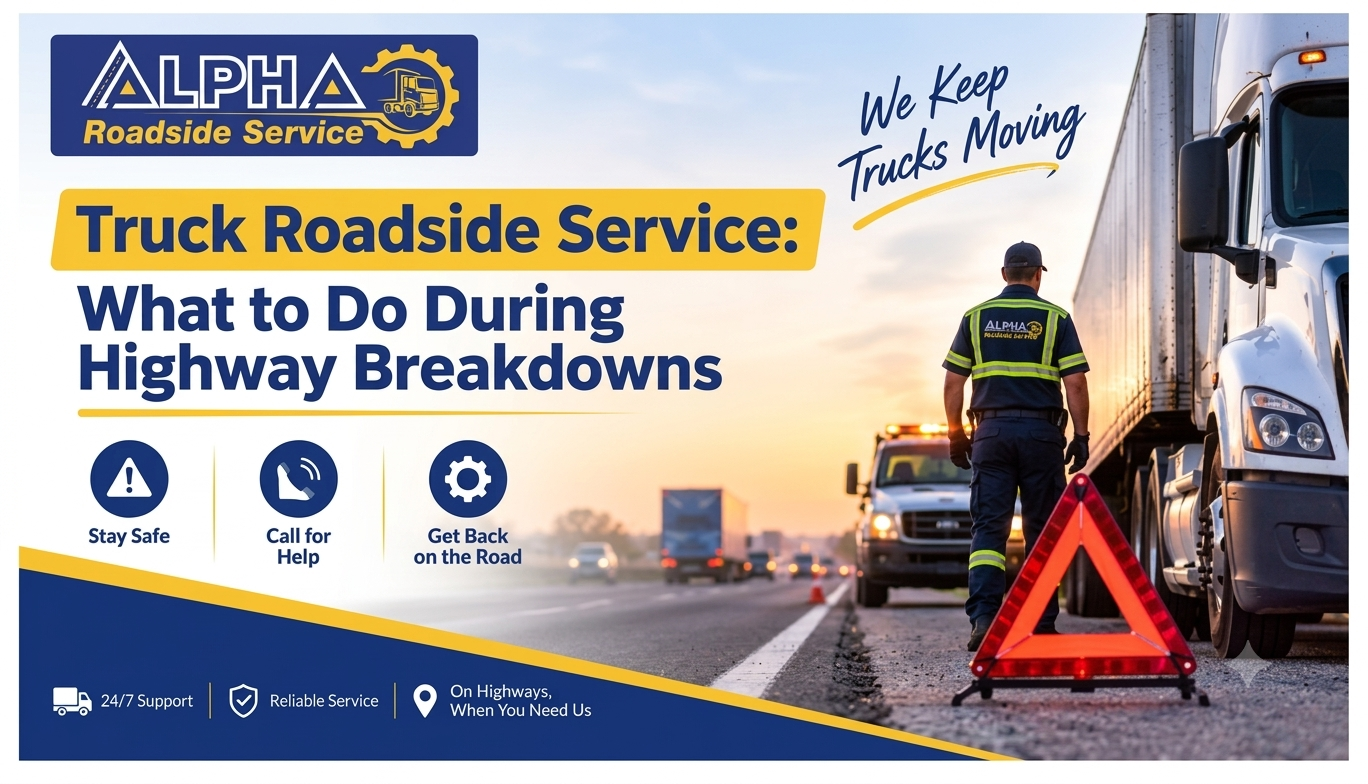
A truck breakdown on the highway can become dangerous quickly.
A commercial truck may be stopped on a narrow shoulder, near fast-moving traffic, or in a location where other drivers have limited visibility. The driver may also be dealing with a flat tire, engine problem, overheating, electrical failure, or another issue that prevents the truck from continuing.
So, what should you do during a highway truck breakdown?
The first priority is not figuring out how to repair the truck. It is getting yourself and the vehicle into the safest practical position, warning approaching traffic, and getting the right assistance.
For commercial vehicles, federal guidance requires specific emergency warning practices when a vehicle is stopped on a highway or shoulder for reasons other than a necessary traffic stop. FMCSA says the hazard warning system should be activated and required external warning devices placed according to the applicable rules.
Once the immediate safety concerns are addressed, truck roadside service can help determine whether the vehicle needs a roadside repair, tire service, mobile diesel mechanic, or towing.
What to Do When Your Truck Breaks Down on the Highway
| Step | What to Do |
|---|---|
| 1 | Stay calm and maintain control of the truck |
| 2 | Move toward a safe location if the truck can be moved safely |
| 3 | Turn on hazard warning lights |
| 4 | Set out required warning devices |
| 5 | Stay away from moving traffic |
| 6 | Determine whether the problem can be safely handled roadside |
| 7 | Call truck roadside service |
| 8 | Give your exact location and truck information |
| 9 | Follow the technician or dispatcher’s instructions |
| 10 | Use towing if the truck cannot be safely repaired or driven |
The exact response depends on where the truck stopped, the nature of the breakdown, traffic conditions, and whether the vehicle can be moved safely.
1. Stay Calm and Keep Control of the Truck
A sudden breakdown can be stressful, particularly when it happens at highway speed.
You may hear an unusual noise, see a warning light, feel the truck pulling to one side, lose engine power, or experience a tire failure.
The first few seconds matter.
Avoid sudden steering movements or aggressive braking unless the situation requires it. If the truck still has enough control and power to move safely, work toward getting it out of the active travel lane.
The objective is to avoid creating another hazard while getting the truck to the safest practical stopping location.
If the truck cannot be moved safely, do not attempt to force it onto the shoulder simply to get it out of the way. A disabled vehicle in a dangerous location may require professional assistance.
2. Move the Truck to a Safer Location If You Can
If the truck is still capable of moving safely, getting it away from active traffic can reduce the immediate risk.
A shoulder, designated emergency area, or other suitable location may provide more separation from passing vehicles.
However, do not drive a seriously damaged truck simply because you want to reach the next exit.
For example, continuing to drive with a severe tire problem, major overheating, serious brake issue, or other dangerous mechanical condition could make the situation worse.
Federal highway safety guidance emphasizes moving disabled vehicles out of travel lanes when they can be moved safely.
If the truck cannot be moved without creating additional danger or damage, call for assistance rather than taking unnecessary risks.
3. Turn On Your Hazard Warning Lights
Once the truck is stopped, make it obvious to approaching traffic that the vehicle is disabled.
Hazard warning lights provide an immediate visual warning to other drivers.
For commercial vehicles stopped on a highway or shoulder because of a breakdown, FMCSA guidance states that the hazard warning system should be activated and remain on until the external warning devices are in position. The hazard warning system should also be used again while those devices are being picked up before the vehicle moves.
This is particularly important at night, in rain, around curves, or anywhere visibility is limited.
4. Use the Required Emergency Warning Devices
Commercial truck drivers should know the warning-device requirements that apply to their vehicles.
FMCSA’s Motor Carrier Safety Planner states that required warning devices must be placed within 10 minutes when a commercial vehicle is stopped on a highway or shoulder for reasons other than a necessary traffic stop. The federal guidance specifies placement distances based on the roadway situation.
The FMCSA guidance describes warning devices positioned approximately:
- 10 feet from the vehicle toward approaching traffic
- 100 feet from the vehicle toward approaching traffic
- 100 feet from the vehicle in the opposite direction
The exact requirements can depend on the roadway configuration and applicable regulations, so commercial drivers should follow the rules applicable to their vehicle and location.
Do not put yourself in danger just to place a warning device. If traffic, visibility, roadway design, or the vehicle’s position makes it unsafe, getting professional or emergency assistance may be more appropriate.
5. Stay Away From Moving Traffic
One of the biggest mistakes during a highway breakdown is treating the shoulder like a normal parking area.
It isn’t.
Passing vehicles may be traveling at highway speed, and drivers approaching a disabled truck may not notice it until they are close.
Avoid standing unnecessarily near traffic or walking around the truck without a clear reason.
If you need to inspect something, consider the traffic conditions, roadway position, visibility, and your ability to remain in a safe location.
FHWA guidance for roadside responders emphasizes minimizing the amount of time people spend standing or walking between vehicles and being especially aware of approaching traffic.
The same principle is useful for truck drivers waiting for assistance.
6. Identify What Happened Before Calling for Help
You don’t necessarily need to diagnose the truck yourself.
However, try to identify the symptoms.
For example:
- Did the truck suddenly lose power?
- Did the engine overheat?
- Did a warning light appear?
- Did you hear a loud noise?
- Did the truck pull to one side?
- Did a tire blow out?
- Did the engine stop completely?
- Is the truck turning over but not starting?
- Is there smoke or an unusual smell?
- Is the trailer affected?
- Can the truck still move safely?
These details can help the dispatcher determine what type of truck roadside service may be appropriate.
You don’t need to be a mechanic.
Your job is to describe what happened as accurately as possible.
7. Call Truck Roadside Service
Once you are in a safer position and the immediate hazards have been addressed, contact a roadside assistance provider.
Explain that you have a highway truck breakdown and provide as much information as possible.
Depending on the problem, roadside assistance may involve:
- Tire replacement
- Battery assistance
- Jump start
- Fuel delivery
- Lockout assistance
- Mobile diesel mechanic
- Emergency roadside repair
- Commercial truck repair
- Trailer repair
- Towing
The goal is to match the response to the actual problem instead of automatically assuming that every breakdown requires a tow.
Alpha Roadside Service currently provides 24/7 roadside assistance for trucks and lists jump starts, fuel delivery, lockouts, battery replacement, and emergency roadside repairs among its services.
8. Give the Dispatcher Your Exact Location
Saying “I’m on the highway” isn’t enough.
A dispatcher needs enough information to locate the truck.
Provide:
- Highway or interstate number
- Direction of travel
- Exit number
- Mile marker, if available
- Nearest cross street
- GPS location
- City
- Shoulder or lane position
- Nearby landmark
- Truck type
- Trailer information
For example:
“I’m on I-635 eastbound near Exit 8. I’m on the right shoulder with a semi and dry van trailer. The truck lost power and won’t restart.”
That is much more useful than:
“My truck broke down on the highway.”
Alpha’s mobile diesel repair process specifically asks drivers to provide their GPS pin, nearest highway exit, mile marker, or business location when requesting service.
9. Tell the Dispatcher What Type of Truck You Have
Truck size and configuration can affect what equipment and technician are appropriate.
Tell the service provider whether you have:
- Semi truck
- Tractor-trailer
- Box truck
- Medium-duty truck
- Heavy-duty truck
- Truck with a trailer
- Other commercial vehicle
Also explain whether the trailer is loaded and whether the problem appears to involve the tractor, trailer, or both.
This information can help prevent an inappropriate service vehicle from being sent.
For example, a heavy commercial vehicle that requires towing may need equipment capable of handling its size and weight. Alpha’s heavy-duty towing service states that towing equipment is matched to the vehicle and towing situation.
10. Don’t Start a Major Repair on the Highway
A highway shoulder is not a repair shop.
Some simple roadside issues may be safely addressed by a qualified technician, but attempting a major repair yourself can expose you to moving traffic, hot components, electrical hazards, or other risks.
This is especially important with:
- Brake problems
- Serious engine failures
- Fuel-system problems
- Major tire damage
- Overheating
- Electrical failures
- Undercarriage damage
If the problem requires professional diagnosis, call a mobile diesel mechanic instead of attempting a repair beyond your experience or equipment.
Alpha’s mobile diesel technicians can diagnose and address certain engine, mechanical, brake, cooling, fuel-system, and tire/wheel issues at the truck’s location when an on-site repair is safe and practical.
When Should You Call a Mobile Diesel Mechanic?
A mobile diesel mechanic can be useful when the truck has a mechanical problem that may be diagnosed or repaired where it is parked.
Examples can include:
- Engine diagnostic issues
- Mechanical problems
- Brake problems
- Cooling-system problems
- Fuel-system issues
- Certain electrical problems
- Some tire and wheel problems
The advantage is that the technician comes to the truck rather than requiring the driver to arrange transportation to a repair facility first.
Alpha Roadside Service specifically describes its mobile diesel service as an option when a truck can potentially be diagnosed or repaired at its current location. If the truck cannot be safely repaired there, towing can be arranged instead.
That creates a practical sequence:
Breakdown → Safety → Diagnosis → Roadside repair if possible → Towing if necessary
When Is Towing the Better Option?
Not every highway breakdown can be repaired on the shoulder.
Towing may be necessary when:
- The truck cannot move safely.
- The vehicle has serious mechanical damage.
- The truck requires shop equipment.
- The breakdown cannot be repaired at the location.
- The vehicle is positioned somewhere unsafe.
- Continuing to drive could cause additional damage.
- A major accident or recovery situation has occurred.
Alpha Roadside Service provides heavy-duty towing and semi-truck towing for commercial vehicles when roadside repair isn’t enough.
The important point is don’t keep driving a truck that isn’t safe to operate simply because you want to avoid towing.
What Not to Do During a Highway Truck Breakdown
Knowing what not to do can be just as important.
Don’t remain in a travel lane if the truck can be safely moved.
A disabled truck in an active lane creates a serious hazard.
Don’t stand unnecessarily close to passing traffic.
The shoulder does not eliminate the danger from moving vehicles.
Don’t attempt repairs you cannot safely perform.
A highway is not the right place to experiment with unfamiliar mechanical work.
Don’t keep driving a seriously damaged truck.
A few additional miles can turn a manageable repair into a much larger problem.
Don’t give an inaccurate location.
A vague location can delay assistance.
Don’t forget the trailer.
If a tractor-trailer is involved, tell the dispatcher whether the trailer is attached and whether it is also affected.
Don’t assume towing is automatically required.
Some problems can potentially be handled by roadside assistance or a mobile mechanic.
What Information Should You Have Ready When Calling?
Keeping a few details available can make the call easier.
| Information | Example |
|---|---|
| Highway | I-635 |
| Direction | Eastbound |
| Exit | Exit 8 |
| Mile marker | Mile 12 |
| City | Dallas |
| Vehicle | Semi truck |
| Trailer | Dry van attached |
| Problem | Engine stopped and won’t restart |
| Location | Right shoulder |
| Safety issue | Heavy traffic |
If you are a fleet driver, you may also need to provide fleet information, vehicle number, or other details required by your company.
How Alpha Roadside Service Can Help After a Highway Breakdown
Alpha Roadside Service combines truck roadside service, mobile repair, and towing, which is useful because a breakdown may change from one type of service to another after the technician evaluates the truck.
Its current service lineup includes roadside assistance, commercial truck repair, trailer repair, tire replacement, semi truck repair, mobile diesel mechanics, truck towing, semi truck towing, and heavy-duty towing.
For example, a driver may initially call because the truck will not start. The problem could turn out to be a battery issue that can be handled roadside. Another truck may have an engine problem requiring mobile diesel diagnostics. A third may have damage that makes towing the safer option.
Alpha’s mobile repair process is built around this distinction: the technician assesses the truck, determines whether an on-site repair is practical and safe, and uses towing when the vehicle cannot be repaired or safely continued.
The company’s DFW service-area page also states that its dispatch team coordinates roadside assistance, mobile repair, and towing throughout the DFW metroplex, including Dallas, Richardson, Mesquite, and surrounding communities.
FAQs About Truck Roadside Service
Q. What should I do first if my truck breaks down on the highway?
A. First, focus on getting the truck to the safest practical position if it can be moved safely. Turn on hazard lights, use the required warning devices, stay away from moving traffic, and contact roadside assistance.
Q. Should I keep driving after a truck breakdown?
A. Only if the truck can be operated safely and the problem does not create a safety or mechanical risk. A serious tire, brake, overheating, engine, or other mechanical problem should be assessed rather than ignored.
Q. What information should I give truck roadside service?
A. Provide your exact location, highway, direction of travel, exit or mile marker, truck type, trailer information, and a description of what happened.
Q. Can a mobile diesel mechanic come to a highway breakdown?
A. Yes. Mobile diesel mechanics can come to a truck’s location when the breakdown may be safely diagnosed or repaired on-site. Alpha Roadside Service provides mobile diesel truck repair throughout its DFW coverage area.
Q. Does truck roadside service include tire problems?
A. It can. Roadside assistance may include tire service or replacement depending on the provider and vehicle. Alpha Roadside Service lists commercial truck tire replacement among its services. (
Q. What if my truck cannot be repaired on the highway?
A. If the truck cannot be safely repaired at its current location, towing may be necessary. Heavy-duty or semi-truck towing can move the vehicle to an appropriate repair destination.
Q. How long should I wait before calling roadside assistance?
A. Don’t wait unnecessarily if the truck is disabled or unsafe to operate. Once you have addressed immediate safety concerns, contact roadside assistance so the appropriate help can be dispatched.
Q. Can I repair a truck myself on the highway?
A. Some minor problems may be manageable for an experienced driver, but highway repairs can expose you to traffic and other hazards. For serious mechanical problems, professional roadside assistance or a mobile diesel mechanic is the safer option.
Q. Is truck roadside service available 24/7?
A. Alpha Roadside Service lists its truck roadside assistance and mobile repair services as available 24/7.
Conclusion
A highway truck breakdown requires more than figuring out how to get the engine running again.
Safety comes first.
Get the truck to a safe location when possible, activate the warning systems, use the required warning devices, stay away from moving traffic, and call for professional help. Give the dispatcher an accurate location and explain what happened so the right type of assistance can be sent.
Depending on the problem, truck roadside service may involve a tire replacement, battery assistance, fuel delivery, emergency repair, or mobile diesel mechanic. If the truck cannot be safely repaired where it stopped, towing may be the appropriate next step.
The key is not to treat every breakdown the same. Assess the situation, protect yourself and others, and get the right help for the truck.