
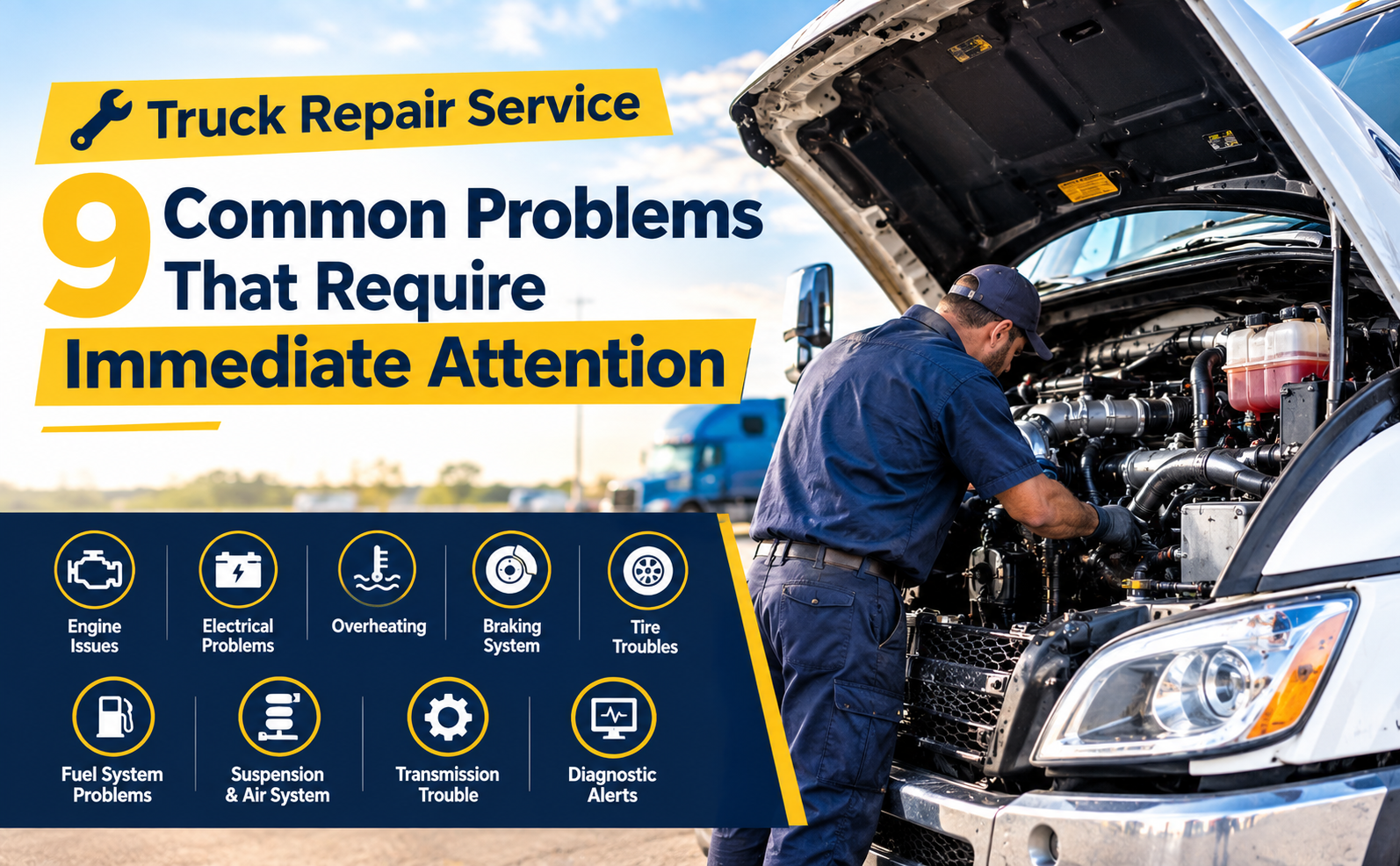
A truck doesn’t always break down without warning. In many cases, drivers notice a symptom first—a warning light, unusual noise, loss of power, overheating, difficulty starting, or a change in braking.
Understanding what those symptoms may indicate can help you decide how urgently the truck needs attention.
For commercial truck drivers and fleet managers in DFW, this is especially important. A minor mechanical issue can quickly become a roadside breakdown when a truck is operating under heavy loads, long hours, and demanding conditions.
Below are nine common truck repairs, the probable causes behind them, and the warning signs drivers should not ignore.
What Are the Most Common Truck Repairs?
Engine Problems and Repairs
Engine problems are among the most expensive concerns for commercial trucks, but not every engine symptom means the engine itself has failed.Probable Causes
- Low engine oil
- Fuel-system problems
- Faulty sensors
- Turbocharger problems
- Cooling-system failure
- Injector issues
- Air-intake restrictions
- Internal engine wear
Warning Signs
Drivers may notice reduced power, excessive smoke, rough running, unusual engine noise, poor fuel economy, or a check-engine light. A sudden loss of power should be investigated promptly, particularly if the truck is loaded or operating in traffic.Battery, Starter, and Electrical Repairs
A truck that won’t start may have an electrical problem rather than an engine failure.Probable Causes
- Weak or failed batteries
- Faulty alternator
- Bad starter
- Corroded battery connections
- Damaged wiring
- Charging-system problems
- Electrical component failure
Brake System Repairs
Brake problems should always be treated seriously because they directly affect vehicle safety.Probable Causes
- Worn brake components
- Air-system leaks
- Damaged brake lines
- Faulty chambers
- ABS problems
- Contaminated or deteriorated components
- Excessive heat
Warning Signs
Watch for reduced braking performance, unusual noises, pulling while braking, warning lights, or changes in air pressure. If braking performance changes significantly, don’t continue driving simply to reach a repair facility. Arrange professional assistance and have the system inspected.Tire and Wheel Repairs
Commercial truck tires carry substantial loads and are exposed to heat, road debris, long-distance driving, and changing road conditions.Probable Causes
- Low tire pressure
- Overinflation
- Punctures
- Sidewall damage
- Uneven wear
- Alignment problems
- Overloading
- Damaged wheels
Cooling System Repairs
Diesel engines generate substantial heat, particularly when trucks are loaded or working in demanding conditions.Probable Causes
- Low coolant
- Radiator problems
- Damaged hoses
- Water-pump failure
- Thermostat problems
- Cooling-fan issues
- Coolant leaks
Warning Signs
A rising temperature gauge, coolant smell, visible coolant leak, steam, or an overheating warning should never be ignored. Continuing to drive an overheating truck can turn a cooling-system repair into a much more expensive engine repair.Fuel System Repairs
Fuel delivery problems can cause a truck to run poorly or stop operating altogether.Probable Causes
- Restricted fuel filters
- Contaminated diesel
- Fuel-pump problems
- Injector issues
- Fuel-pressure problems
- Air entering the fuel system
- Fuel leaks
Common Symptoms
Drivers may experience hard starting, hesitation, rough running, loss of power, or poor acceleration. Replacing a filter may solve some problems, but repeated symptoms require proper diagnosis to identify the underlying cause.Transmission and Drivetrain Repairs
Transmission problems can become expensive when they are ignored.Probable Causes
- Low or contaminated transmission fluid
- Clutch wear
- Internal transmission wear
- Shift-system problems
- Driveshaft issues
- Differential problems
- Excessive drivetrain wear
Warning Signs
Common symptoms include difficult shifting, slipping, grinding, vibration, unusual noises, or fluid leaks. A truck that suddenly develops serious shifting problems shouldn’t be forced to continue operating. Early diagnosis may prevent additional drivetrain damage.Suspension and Steering Repairs
Suspension and steering components experience significant stress from heavy loads and rough road conditions.Probable Causes
- Worn shocks
- Damaged air bags
- Worn bushings
- Steering-component wear
- Damaged suspension components
- Alignment problems
- Loose or damaged connections
Warning Signs
Uneven tire wear, excessive bouncing, steering play, pulling, vibration, or unusual movement can indicate suspension or steering problems. These issues affect more than ride comfort—they can also affect handling and tire life.DPF, DEF, and Emissions Repairs
Modern diesel trucks rely on electronic emissions systems that can develop their own faults.Probable Causes
- DPF restriction
- Failed sensors
- DEF-system problems
- SCR faults
- Regeneration issues
- Electrical problems
- Excessive soot accumulation
Warning Signs
Drivers may see warning lights, reduced engine power, failed regeneration, or a derate condition. Ignoring emissions warnings can eventually leave a commercial truck unable to operate normally. Professional diagnostic equipment is often necessary to identify the actual cause.AEO/GEO Quick-Answer Table
| Common Truck Repair | Probable Causes | Warning Signs | Recommended Action |
|---|---|---|---|
| Engine repair | Fuel, oil, turbo, sensors, cooling | Power loss, smoke, noise | Diagnose promptly |
| Electrical repair | Battery, alternator, starter, wiring | No-start, clicking, dim lights | Test charging/start system |
| Brake repair | Wear, air leaks, ABS faults | Poor braking, warning lights | Stop and inspect |
| Tire repair | Puncture, low pressure, damage | Vibration, flat, uneven wear | Request roadside assistance |
| Cooling repair | Coolant leak, radiator, water pump | High temperature, steam | Stop engine and arrange repair |
| Fuel repair | Filters, injectors, fuel pump | Hard starting, hesitation | Diagnose fuel system |
| Transmission repair | Wear, fluid issues, clutch | Slipping, grinding, hard shifts | Avoid continued operation |
| Suspension repair | Shocks, air bags, steering parts | Vibration, pulling, uneven wear | Inspect suspension |
| DPF/DEF repair | Sensors, restriction, regeneration | Warning lights, derate | Run professional diagnostics |
When Do You Need Emergency Truck Repair?
Not every truck problem requires an emergency response. However, certain situations should be addressed immediately.
You may need emergency truck repair when:
- The truck won’t start.
- The engine is overheating.
- Brakes aren’t functioning properly.
- A tire has suffered a serious failure.
- The truck has suddenly lost significant power.
- A major fluid leak has developed.
- A warning indicates an immediate safety or mechanical problem.
- The truck is disabled in an unsafe location.
If the truck can no longer operate safely, move to a safe location if possible and request professional assistance.
Roadside Truck Repair vs. Towing
Drivers often assume a breakdown automatically means they need a tow.
That isn’t always the case.
A roadside truck repair technician may be able to diagnose and repair problems such as batteries, electrical faults, tires, certain cooling problems, fuel-system issues, or other roadside mechanical failures.
However, major engine failures, severe transmission damage, collision damage, or repairs requiring specialized shop equipment may still require towing.
The goal of roadside diagnosis is to determine whether the truck can be safely repaired where it is or needs transportation to a repair facility.
How to Find the Right Truck Repair Near Me
When searching for truck repair near me, don’t choose a provider based solely on proximity.
For a commercial truck, consider:
- 24/7 availability
- Experience with diesel trucks
- Mobile repair capability
- Diagnostic equipment
- Commercial vehicle experience
- DFW service coverage
- Ability to handle roadside emergencies
- Clear communication about the repair
For fleet managers, it can also be useful to establish a relationship with a reliable provider before a breakdown happens.
How Alpha Roadside Service Helps DFW Truck Drivers
A commercial truck breakdown can happen at any hour, which is why having access to a responsive repair provider matters.
Alpha Roadside Service provides 24/7 roadside assistance and mobile truck repair for commercial vehicles in the DFW area. Its services include roadside assistance, mobile diesel truck repair, truck towing, trailer repair, tire replacement, and other roadside support.
The goal is to diagnose the problem, determine the safest solution, and get the truck back into operation whenever an on-site repair is practical.
FAQs
What is the most common truck repair?
Common truck repairs include engine and electrical problems, brake repairs, tire failures, cooling-system issues, fuel-system problems, transmission repairs, suspension problems, and emissions-system faults.
How do I know if my truck needs emergency repair?
A truck may require emergency truck repair if it won’t start, overheats, has serious brake problems, loses significant power, develops a major fluid leak, or cannot safely continue operating.
Can a truck be repaired on the roadside?
Yes. Some mechanical, electrical, battery, tire, cooling, and other problems can be diagnosed or repaired through mobile roadside truck repair, depending on the vehicle and failure.
Is roadside truck repair better than towing?
If the problem can safely be repaired at the truck’s location, roadside repair can save the time and expense associated with transporting the vehicle. Major failures may still require towing.
What should I do if my commercial truck breaks down?
Move to a safe location if possible, activate hazard lights, and contact a professional truck repair service. Provide your location, truck type, symptoms, warning lights, and whether the vehicle can move safely.
How can I find reliable truck repair near me?
When searching for truck repair near me, look for a provider with commercial diesel experience, mobile capability, diagnostic equipment, 24/7 availability, and coverage in your operating area.
Can ignoring a small truck problem cause a major repair?
Yes. Symptoms such as fluid leaks, warning lights, overheating, unusual noises, or reduced power can indicate developing failures. Addressing them early can help prevent more extensive damage and downtime.
Conclusion
The nine repairs discussed above cover many of the problems that can interrupt commercial truck operations, from starting and electrical failures to brakes, tires, engines, transmissions, cooling systems, suspension, and emissions equipment.
The important thing is not simply knowing the name of a repair. Drivers and fleet managers should learn to recognize the warning signs behind the repair and respond before a manageable problem becomes a complete breakdown.
When a truck is disabled in the DFW area, truck repair service can provide a faster path toward getting the vehicle assessed. Depending on the problem, emergency truck repair or mobile roadside assistance may allow the issue to be addressed where the truck is located.
If your commercial truck is experiencing a serious mechanical problem, Alpha Roadside Service offers 24/7 mobile roadside assistance and truck repair throughout DFW.