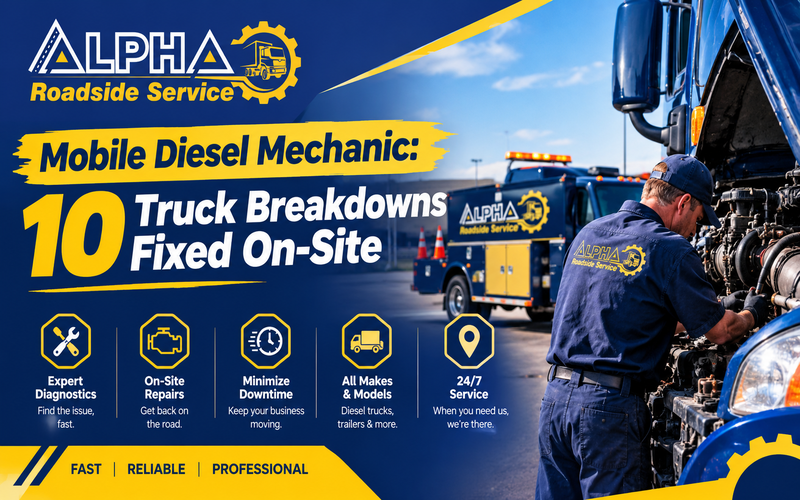
When a truck goes down, most drivers assume the next step is a tow. But towing a loaded semi is expensive, slow and often unnecessary.
A good mobile diesel mechanic shows up with a service truck full of tools, diagnostic software and common parts. In many cases, the repair happens right where your truck is parked, whether that’s a highway shoulder, a truck stop, a customer’s dock or your own yard.
The question is: which problems can actually be fixed on-site? Most search results won’t tell you. They list services, not real breakdowns. So we will.
Alpha Roadside Service has more than 20 years of truck repair experience across Texas. Here are the 10 breakdowns our mobile mechanics fix on-site most often, plus the honest list of jobs that still belong in a shop.
A mobile diesel mechanic can fix many common truck breakdowns on-site, including dead batteries, starter and alternator failures, tire blowouts, air brake leaks, brake chambers and slack adjusters, belts and coolant hoses, fuel filters and air in the fuel system, sensor faults and many derates, lighting and trailer wiring, and trailer issues like air lines and landing gear. Major engine, transmission, clutch and frame repairs usually need a shop.
On-Site or Shop? The Short Version
| Breakdown | Usually fixed on-site? | When it needs a shop |
| Dead batteries, cables, alternator, starter | Yes | Major wiring harness damage |
| Tire blowout or flat | Yes | Damaged hub, axle or wheel end |
| Air brake leaks, chambers, slack adjusters | Yes | Compressor or major brake overhaul |
| Belts, hoses, coolant leaks | Yes | Radiator or water pump in a tight spot, sometimes |
| Fuel filters, priming, water in fuel | Yes | High-pressure fuel pump failure |
| Sensors and many derates | Often | Internal aftertreatment failure, DPF cleaning |
| Lights and trailer wiring | Yes | Rarely |
| Trailer air lines, gladhands, landing gear | Yes | Major trailer frame damage |
| Gelled fuel | Often | Severe contamination |
| Turbo, injectors | Sometimes | Depends on access and parts |
| Engine internal, transmission, clutch | No | Always a shop job |
1. Dead Batteries and Starting Problems
This is one of the most common calls we get. Overnight idling, sleeper electronics and Texas heat all wear down batteries.
What we fix on-site:
- Battery testing and replacement
- Cleaning and repairing corroded cables and terminals
- Ground connection repairs
- Starter replacement
- Alternator testing and replacement
A jump might get you rolling, but if the batteries or alternator are failing, you’ll be stuck again. We test the whole charging system so the fix lasts.
2. Tire Blowouts and Flats
A blowout can happen to anyone, especially with summer pavement temperatures and heavy loads.
What we fix on-site:
- Steer, drive and trailer tire replacement
- Mounting and torqueing wheels to spec
- Checking nearby tires and brake components for blowout damage
Our tire replacement team carries heavy-duty tires for trucks, trailers and RVs, so most tire calls are done in one visit.
3. Air Brake Leaks and Brake Components
Air brake problems are a safety issue and a common reason trucks fail inspections. The good news: most air system repairs can be handled on-site.
What we fix on-site:
- Leaking air lines and fittings
- Brake chambers, including spring brake chambers
- Slack adjusters
- Valves and quick-release fittings
- Air dryer service
If you hear a hiss, see air pressure dropping or get a low-air warning, don’t keep driving. Call for help.
4. Belts, Hoses and Coolant Leaks
Cooling system failures can overheat an engine fast, especially in Texas summers or on a long pull with a heavy load.
What we fix on-site:
- Serpentine and drive belts
- Coolant hoses and clamps
- Thermostat replacement in many cases
- Fan clutch issues
- Topping off and checking coolant
If you catch a coolant leak early, it’s usually a straightforward on-site repair. If you keep driving while overheating, it can turn into an engine repair.
5. Fuel Filters, Air in the Fuel and Water Separators
Fuel problems are a big cause of power loss and no-starts. Running low on fuel, overdue filters or bad fuel can all stop a truck.
What we fix on-site:
- Primary and secondary fuel filter replacement
- Draining water separators
- Priming and bleeding air from the fuel system
- Lift pump diagnosis and replacement in many trucks
- Fuel line leaks
6. Sensor Faults and Derates
Newer trucks rely on dozens of sensors. When one fails, the truck may go into derate, limiting speed and power.
Our mobile diesel mechanics carry diagnostic tools for Volvo, Detroit, Cummins and PACCAR systems. That means we can read fault codes, look at live data and find the real problem.
What we fix on-site:
- NOx, temperature, pressure and other sensors
- DEF system issues like contaminated fluid or faulty components
- Wiring and connector problems
- Forced regenerations when appropriate
- Clearing codes after the repair
Not every derate is fixable roadside. A DPF that needs to be cleaned, for example, usually needs special equipment.
7. Lighting and Electrical Problems
Broken lights are one of the easiest ways to get stopped, and dangerous at night.
What we fix on-site:
- Headlights, brake lights, turn signals and marker lights
- Trailer wiring and the 7-way connector
- Shorts and blown fuses
- Corroded connections
8. Trailer Problems
Sometimes the truck is fine and the trailer is the problem. Our trailer repair service handles dry vans, reefers, flatbeds and utility trailers.
What we fix on-site:
- Air lines and gladhands
- Trailer brakes
- Landing gear
- Lights and wiring
- Doors, latches and hinges in many cases
9. Gelled Fuel in a Cold Snap
Texas doesn’t freeze often, but when it does, diesel can gel and clog filters. We can warm the system, replace filters and get the fuel flowing again in many cases. Using winter-blend fuel or an anti-gel additive before a cold front helps prevent it.
10. Turbo and Injector Issues (Sometimes)
Some turbo and injector problems can be diagnosed and repaired on-site, depending on the truck, access to the part and whether the part is in stock. We’ll tell you honestly whether it makes sense to fix it where you are or move the truck to a shop.
What Usually Needs a Shop
A mobile mechanic who tells you everything can be fixed roadside isn’t being honest. These jobs typically need a shop:
- Internal engine repairs or rebuilds
- Transmission and clutch replacement
- Major suspension or frame repairs
- DPF cleaning
- Big collision damage
- Repairs that need the truck lifted for hours
When a truck needs a shop, our semi truck towing and heavy duty towing teams can move it safely.
Why On-Site Diesel Truck Repair Saves Money
- No tow bill, which can be large for loaded heavy trucks
- Less downtime, often hours instead of days
- Fewer missed loads and late deliveries
- Yard visits for fleets, so trucks are serviced without pulling drivers off routes
How to Get Faster Mobile Diesel Truck Repair
When you call, share:
- Your exact location: highway, direction, exit or a GPS pin
- Truck make, model, year and engine
- Symptoms, warning lights and fault codes
- Photos of the problem, if possible
- Whether you’re loaded and on a deadline
That way, the mechanic arrives with the right parts.
Need a Mobile Diesel Mechanic Near You?
Alpha Roadside Service provides 24/7 roadside assistance, semi truck repair, box truck repair, heavy duty truck repair and commercial truck repair across Texas, including Dallas, Richardson and Mesquite.
Call +1 (855) 457-1170 or request a service. You’ll get an upfront quote before work begins.
Frequently Asked Questions
What can a mobile diesel mechanic fix on-site?
Batteries, starters, alternators, tires, air brake components, belts, hoses, fuel filters, sensors, lighting, wiring and many trailer issues.
Can a mobile mechanic fix a derate?
Often, yes. Many derates come from sensors, wiring or DEF issues that can be diagnosed and repaired on-site.
Is mobile diesel truck repair more expensive than a shop?
Not usually when you include towing and downtime. You’ll get a quote before work starts.
What repairs can’t be done roadside?
Internal engine work, transmission and clutch replacement, major frame or suspension repairs and DPF cleaning usually need a shop.
How fast can a mobile diesel mechanic reach me?
Alpha Roadside Service’s average ETA is 60 to 90 minutes for mobile repair calls, depending on location and traffic.