
It’s 2 AM on I-20. A warning light comes on, or the truck starts pulling, or you hear a hiss that wasn’t there an hour ago. Now you’re stuck with the question every driver has faced: Do I keep going and deal with it later, or do I call someone now?
Guess wrong, and a small issue can turn into a blown engine, a damaged trailer or a dangerous situation on the shoulder. Call too early, and you worry you’re wasting time.
At Alpha Roadside Service, we take roadside assistance calls from truck drivers across Texas at every hour. Here’s a practical guide on when to call, what to say when you do and how to stay safe while you wait.
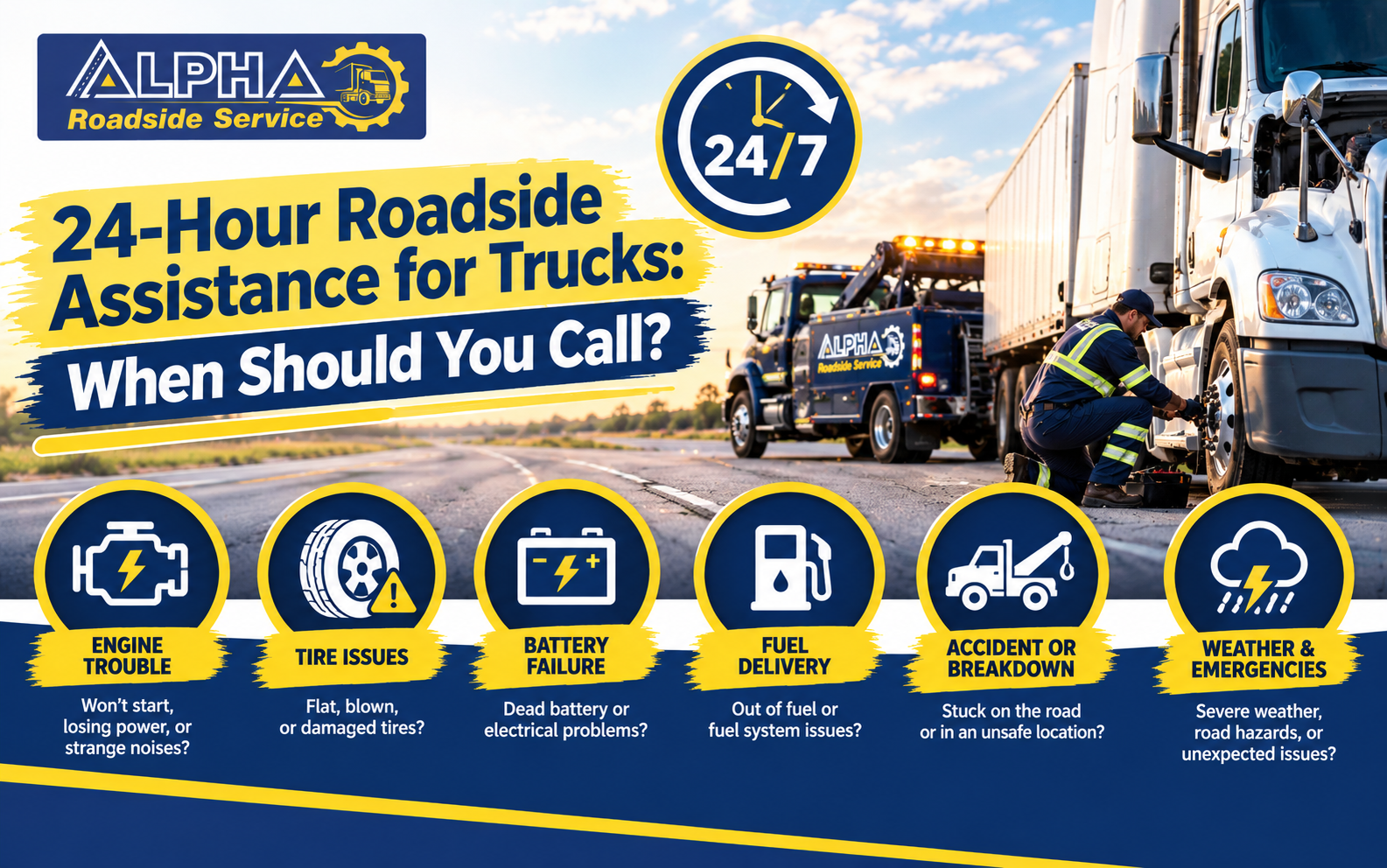
Call 24-hour roadside assistance for your truck when it can’t be driven safely or legally: a tire blowout or flat, air brake problems, a no-start or dead batteries, overheating, a sudden derate or loss of power, fuel problems, electrical failures or any warning that affects steering, braking or visibility. If the problem puts you or others at risk, stop and call right away.
Signs You Should Call Right Away
Some problems simply can’t wait. If any of these happen, find a safe place to stop and call for emergency roadside assistance.
1. A Tire Blowout or Flat
A truck tire failure can affect handling, damage the truck and leave debris on the road. Driving on a flat can also damage the wheel, brakes and nearby tires.
Our tire replacement team carries heavy-duty tires for trucks and trailers, so most tire calls are handled on the spot.
2. Air Brake Problems
A low-air warning, dropping air pressure, a loud hiss or brakes that feel weak are serious. Air brake issues can quickly become a safety risk for you and everyone near your truck.
Don’t try to push through to the next exit. Stop safely and call.
3. The Truck Won’t Start
Whether it’s dead batteries, a starter problem or a diesel that cranks but won’t fire, a no-start can leave you stuck at a truck stop, customer site or shoulder.
Many no-start issues can be diagnosed and fixed on-site with the right tools.
4. Overheating
A climbing temperature gauge, steam or coolant on the ground means the cooling system is in trouble. Texas summers push cooling systems hard, especially in traffic or on long pulls with heavy loads.
Keep driving and you risk serious engine damage. Pull over, shut it down if it’s safe to do so, and call.
5. A Sudden Derate or Loss of Power
When the truck limits your speed or loses power, the ECM is protecting the engine. The cause could be an emissions issue, a sensor failure, a fuel problem or something else.
Losing speed on a busy interstate can be dangerous. A mobile mechanic can read the codes and often fix the issue without a tow.
6. Electrical Failures
If your headlights, trailer lights, brake lights or turn signals stop working, other drivers can’t see what you’re doing. That’s especially risky at night.
Electrical problems can also point to a failing alternator, which means the truck may shut down soon.
7. Fuel Problems
Running out of fuel, getting bad fuel or fuel gelling in a cold snap can stop a truck completely. Diesel engines also may need the fuel system primed after running dry.
Our roadside team can bring fuel and help get the system running again.
Problems That May Be Able to Wait
Not every warning means stopping on the shoulder. Some issues can often wait until you reach a safe stop or the end of your shift:
- A minor oil or coolant seep with normal gauge readings
- A burned-out marker light, as long as required lights still work
- A small, non-urgent fault code with no change in performance
- A comfort issue, like a broken seat or cab AC
Even then, don’t ignore it. Get it checked soon. Small issues get more expensive when they’re left alone. And if you’re not sure whether something can wait, call and ask. A dispatcher can help you decide.
What to Tell Dispatch When You Call
The more you share, the faster we can help. Have this ready:
- Your exact location. Highway, direction, nearest exit or mile marker, or a GPS pin.
- Truck details. Make, model, year and engine, if you know it.
- What’s happening. Warning lights, fault codes, sounds, smells or leaks.
- Load details. Whether you’re loaded, empty or hauling hazmat.
- Your safety situation. Whether you’re fully off the road or in a risky spot.
With that information, we can send the right mechanic with the right parts, or arrange a tow when a roadside fix isn’t possible.
How to Stay Safe While You Wait
A truck on the shoulder is a target for distracted drivers. Take these steps while help is on the way:
- Get as far off the road as you can. A wide shoulder, exit ramp or parking area is best.
- Turn on your hazard lights right away.
- Set out your reflective triangles. Federal rules require warning devices to be placed within 10 minutes of stopping.
- Wear a high-visibility vest if you need to step outside.
- Stay away from the traffic side of the truck.
- Stay in the cab if it’s safer than standing outside.
Texas also has a Move Over or Slow Down law that requires drivers to change lanes or slow down for stopped emergency and service vehicles. Unfortunately, not every driver follows it. Stay alert.
Why 24-Hour Roadside Assistance Matters for Commercial Trucks
For commercial fleets and owner-operators, a breakdown isn’t just a repair bill. It’s a missed delivery, a waiting customer and a driver losing hours on the clock.
Commercial truck roadside assistance that runs 24/7 means:
- Less downtime, since help is available at night, on weekends and on holidays
- Fewer tows, because many problems are fixed on-site
- Safer roads, since disabled trucks get moved or repaired faster
- Better planning, with upfront quotes so fleet managers know what to expect
When a repair can’t be done roadside, our semi truck towing and commercial truck towing teams can move the truck to a shop.
24/7 Roadside Assistance for Trucks Across Texas
Alpha Roadside Service has helped Texas drivers and fleets for more than 20 years. Our live dispatch runs 24 hours a day, 7 days a week, including holidays. We provide mobile diesel mechanic service, semi truck repair, trailer repair and towing across Dallas, Richardson, Mesquite and the rest of Texas.
Call +1 (855) 457-1170 or request a service. Fleets can also become a member for ongoing support.
Frequently Asked Questions
What does 24-hour roadside assistance for trucks include?
It usually covers tire service, jump starts, battery replacement, fuel delivery, lockouts, minor mechanical repairs and towing when needed.
When should a semi truck driver call emergency roadside assistance?
Call right away for blowouts, air brake problems, overheating, no-starts, sudden derates, electrical failures or anything that makes the truck unsafe to drive.
How fast can roadside assistance reach me in Texas?
Our average ETA is 60 to 90 minutes for standard mobile repair calls, and often faster for local roadside help in the DFW area, depending on traffic and location.
Can roadside assistance fix a semi truck without towing it?
Often, yes. Many tire, brake, battery, sensor and fuel system issues can be repaired on-site.
Do you offer commercial truck roadside assistance for fleets?
Yes. We support both one-time calls and ongoing fleet agreements.